Showing posts with label hobbies. Show all posts

Sunday, October 28, 2012

Return to Azeroth


“I have come here to chew bubblegum and kick ass... and I’m all outta bubblegum.”

Two weeks ago I began playing the (in)famous game World of Warcraft again. Despite my list of pros and cons having the cons slightly ahead, I ended up heading back into Azeroth for another round of adventuring and questing. The last time I actively played was during the expansion Wrath of the Lich King, specifically, patch 3.2 “Call of the Crusade”. Since I said my goodbyes to my Guild back in January 2010,  two expansions have come out - Cataclysm (October 2010) and Mists of Pandaria (September 2012), with “MoP” putting the game patch version at 5.0.x. Cataclysm made some pretty major changes to the game, especially in the layout of some of the zones and the ability to use flying mounts in Azeroth proper.1 So much has changed, that I almost don’t know where to begin. For example, it’s rather embarrassing, being that I play an Orc, to say that I now get lost in the Orcs’ capital city of Orgrimmar because it’s changed so dramatically since last I played. Not only have classic zones been revamped, but the game system itself has changed quite a bit as well.


Class and Race Combinations:

To briefly summarize, for those that may not be familiar with the game, classic, “vanilla”, WoW included eight playable races. For the Alliance - Human, Night Elf, Dwarf, and Gnome; For the Horde - Orc, Troll, Tauren, and Undead . There were also nine classes - Warrior, Mage, Druid, Priest, Shaman, Hunter, Rogue, Paladin, and Warlock. Burning Crusade (patch 2.0) added two races; Dranei for the Alliance and Blood Elves for the Horde. Adding Blood Elves to the Horde also gave that faction a race that could play the Paladin class for the first time.  Wrath of the Lich King (patch 3.0) added a new class; the Death Knight.

Cataclysm (patch 4.0) added two new races to the game - for the Alliance, the Worgen and for the Horde, Goblins. These races, most notably Goblins, had always been present, just not as a playable race. This expansion also added several new options for Race-Class combinations, such as Paladin as an option for the Taurens, giving the Horde two races who could play that class instead of just one, and compared the the three races within the Alliance that could be Paladins. There are several other new combinations as well with classes being added as options for races that previously were not possible.


Mists of Pandaria (patch 5.0), which I have not purchased a license for yet,3 adds a new playable race, Pandaren, as well as a new class, Monk. Yeah, I know - apparently the folks at Blizzard watched a lot of “Kung Fu Panda” while working on ideas for the fourth expansion.

New Zones, Rearranged Zones, and Flying Around in All of It:

A few months after Cataclysm had come out, and roughly a year after I had quit playing, I was offered ten days of free game time as an enticement. I took the ten free days because I wanted to see what had changed about the zones. Ten days wasn’t nearly enough time to explore all of it, though. But the new ability to use flying mounts almost everywhere certainly makes it a bit easier.

First of all, flying mounts were previously only usable in Outland, which was introduced in patch 2.0 Burning Crusade (which also introduced flying mounts to begin with) and Northrend (patch 3.0 Wrath of the Lich King) once the Cold Weather Flying skill was purchased. Now, though, flying is available anywhere, even in the classic zones, once the character has purchased the skill called Flight Master’s License (a mere 250 gold).4  Getting the Flight Master’s License is, without a doubt, a necessity to be able to quest and explore for higher level characters.

There are, frankly, too many changes here for me to try to go into all of them, especially since I have had the time to explore it all yet. Some of the more notable (to me) changes are Orgrimmar, the capital city of the Orcs and the Barrens. Orgrimmar looks completely different now and is multi-tiered with lifts to get to the upper tier. There’s been new construction under the new Warchief as well. The city is actually larger now, and I mentioned before, I get lost in it, but I’m learning my way around. The Barrens has been split into two zones, Northern Barrens and Southern Barrens, instead of just one huge zone. I’m pretty sure that prior to the Cataclysm, it was the largest zone in the game. I hated questing in the Barrens, just because of the sheer size of it, and at levels that were too low to be able to get the riding skill and a mount. Now that it’s been split in two, with the Northern Barrens being a lower level zone and Southern Barrens being a mid-level zone, it’s not quite as bad and questing in that zone from levels 10-20 gets completed a lot faster. For more information, check out the WoWWiki Cataclysm page.

Other Stuff of Note:

There are lots of other things that have changed that I am continuing to discover, but to be honest, this blog post would begin getting out of hand (or turn into a two or three part blog over the next few weeks) if I started trying to detail every little thing. There are new guild recruiting and search tools, certain things, like mounts, etc. that were previously “soulbound” to a character are now account bound and useable by any character. Flight points, which previously had to be discovered, are now automatically added as a character levels up so they know them for the zones that are level appropriate to them. Patch 5.04 added something called “Pet Battles” wherein companion, non-combat, pets that were obtained more to get an achievement for collecting them, can now be trained for do battle (albeit, only with other battle pets). Gathering professions such as skinning and herbalism no grant experience points. Speaking of experience points, the experience gains from from quests and combat seem to have been dramatically increased (at least at lower levels). Drop rates have improved - I refer here most notably to the previously mentioned zone, the Barrens, where you’d have to kill four or five beasts to get the one hoof or horn or whatever the fuck the quest called for. Now it’s more like kill two to get one (much much better than before). Archeology was added as another secondary skill - the previous list of secondary skills was First Aid, Cooking and Fishing.

I’ve only been back in the game for a couple of weeks, and I haven’t even bought the most recent expansion yet, so I’m sure I’ll uncover more fun new stuff that wasn’t there before. But for now, I’m just enjoying the adventure.

~ JC

Footnotes:

1. By “Azeroth proper” I mean the original zones located on the continents of Eastern Kingdoms and Kalimdor. Flying mounts were introduced in the first expansion, Burning Crusade, and were only usable in the area known as “Outland”. They were also allowed in the area “Northrend” which was introduced in the Wrath of the Lich King expansion. Cataclysm allowed Blizzard to completely revamp and rewrite the code for the original areas making flying mounts possible there.

2. Previously the only Horde race that could choose Paladin were Blood Elves (compared to Human, Dwarf and Dranei for the Alliance).

3. In other words, while I have access to most of the new content, purchasing a license for the most recent expansion would allow me full access to play a Pandaren or a Monk as well as new dungeon and raid content.

4. I could go into a whole rant about how certain things in the game are obviously designed to be a huge gold sink while other things have been extremely reduced in price since I first started playing, but I won’t. Suffice it to say that I really wish Blizzard would make up their mind about how much the riding skills will cost in terms of in-game currency because it still seems unbalanced to me. I mean, really - 5,000 gold to learn fast flying and another 5,000 for very fast flying - Why?

Sunday, November 06, 2011

Phasing in a New Army

When I moved to Atlanta last October, one of the new hobbies I took up was the game Warhammer 40,000 (also known as 40k, for short). Being of Scottish ancestry, the army I selected to play was called the ‘Space Wolves’, a Space Marine chapter. Yes, I know, Space Wolves fluff and back story is based on Norse mythology, not Celt, but it’s the closest thing to Celt Mythos in the 40k Universe, so that’s what I went with.

Unfortunately, I soon found out that the Space Wolves were also amongst the most popular of Space Marine chapters to play. The upside to that, of course, was always being able to find models for that army at the local gaming store. The downside is, to damn many people were playing that army. The only thing I could really do to make my army stand out was go with a slightly different color scheme when painting them compared to most other players using the color scheme presented in the Space Wolves Codex.

After a few months of playing Space Wolves, I actually started getting a bit bored of them. After all, they’re really just another Space Marine chapter amongst dozens of Space Marine chapters. I wanted to play something different.

The one army I never saw anyone play at Giga-bytes Café was the Necrons. I became intrigued. So I looked through their codex and I very much liked what I saw. I also really liked the look of the models. An army of immortal living robots? Awesome! It would be like playing an entire army of Schwarzenegger-esque terminators. They even had a special rule called “We’ll Be Back”. How awesome was that?

So, I started buying up the little bit of Necrons models that Giga-bytes had in stock with plans to have the owner order more as I decided exactly how I wanted to build my list. Then something happened that made me excited and sad at the same time. I had to post-pone the building of my new army because the models had all become back ordered from Games Workshop. WTF!?

See, Warhammer 40k is currently on the 5th edition of its rule set, but the Necrons Codex was still from 4th edition as it had not been updated for 5th yet. The reason everything had become backordered and unavailable was because GW was finally updating the Necrons for 5th edition. This was exciting because it mean newer, updated special rules for this army and possibly new models as well. The part that made me sad was that my reason for wanting to play this army was potentially about to be nullified. See, I wanted to play Necrons because no one else at my hobby store did. The typical MO when an army gets updated is that a shit-ton of people all of a sudden starts buying up models for it. It’s like everyone has “ooo shiny!” moment and thinks they just have to have it because it’s the newest thing to hit the shelves.

After a months of waiting for the new codex to come out, the day finally arrived yesterday! GW finally released the new codex for Necrons and also introduced several very new, very sexy models for this army. And the timing on this was even better because my birthday is next week, so I ended up getting an early birthday present from my fiancée.

I am very thankful of the fact that, so far, the only person who actually reserved anything for the new release other than a copy of the new codex was me. And no one can accuse me of being a “band wagon” buyer of this new set of models because I had already started this army and planned on playing it before I even knew that GW was updating it for 5th edition.

So, I have some models to build and paint now that I’m actually looking forward to. And more importantly, I’m really anxious to get this army built so I can play it. I’d say the odds are pretty good that I’ll end up getting my Necrons army built up to a full 2000 point list well before I get my Space Wolf army completed.
With that said… I’ve got a codex to read and models that need building.

~JC


Saturday, August 27, 2011

The Art of Mastering the Game


I've been playing role playing games, in one form or another, for about 26+ years (I started playing Dungeons & Dragons ™ when I was 13; I'm now 39 – do the math). Which means, I've been playing these types of games for longer than some of the members of my current gaming group have even been alive (holy shit, I'm old!). There are a couple of things that make these games fun; for me anyway. There's the social interaction, for one, but mostly it's just fun to be able to vent frustrations by portraying a character that can do things that I can't – either because I don't have the skills, or because in the real world, I'd be in jail if I did many of things my characters have done in game. There's also the fact that by participating in a role playing game, I get the feeling that I'm one among a group of authors who are collaborating to “write” an open ended story. I've always wanted to write a novel, but anytime I get an idea and start writing, I realize that I'm just rehashing typical fantasy stories, or my idea is to much like some author's work, and I really don't want to get sued, so I stop writing. Playing an RPG helps to satiate my desire to write.

The balancing act of keeping the game fun and interesting falls squarely in the lap of the Game Master (aka, Dungeon Master, Storyteller, Weaver, referee, etc.). The GM, has the job of coming up with the setting and plot of this open ended story – sometimes using published works specifically written for the game, sometimes coming up with their own (or, in the case of games I have run as GM, a combination of both). The players, portraying various characters within the setting, collaborate with the GM to unfold a dynamic story.

The challenge any GM has is to not only come up with a story arc that is compelling and draws the players in, but to also keep a balance withing the mechanics of the game. Almost every RPG uses statistics and dice to help determine outcomes. It's all well and good for me to announce that my player performs a certain action, but, as in real life, success is not a foregone conclusion, so dice are rolled and compared to the character's abilities and skills versus how difficult the task is, or versus another character's ability to out maneuver or out smart the player's character. For example, a decide that my character wants to climb a wall and he has a climbing skill of, let's say +2. I roll a twenty sided die (d20), and add my +2 climbing skill to the die roll. The GM then has to decide just how difficult this particular wall is to climb; is it smooth, or does it have spots that jut out that could be used for hand and foot holds? He/she sets a target number that the character has to meet to succeed. So, for this example, we'll say that it's not a terribly high wall, and has places to grab, so the GM sets the target number at 10. I roll a 9 on the d20, adding my +2 for my climbing skill for a total of 11. My character succeeds in climbing the wall. The trick is, the GM has keep mechanics like this balanced – and by balanced I mean both fair and challenging. Sometimes, a task is very simple, sometimes it's challenging, and sometimes it's downright heroic or epic in scope. If the GM sets the target numbers to low, the games not challenging enough. If he sets them to high, then players get upset that there's no way to succeed (player characters, for the record, tend to be better than average in certain skills by design – that's kind of the point, the players are portraying characters intended to be heroes in the story). (1)

There are good GM's, there are great GM's, and unfortunately there are also bad GM's. Some people just can't tell a good story. Others have a GM vs the Players attitude. Some give the players to much, others don't give the players enough. As I said, it's a balancing act, and the truth is, not everyone who plays RPGs is capable of being a GM. And that's all I have to say about that.

~ JC

(1) this example happens to be from the d20 System – there are systems that utilize 10-sided dice or 6-sided dice. My example in no way is intended to, necessarily, advocate that the d20 system is any better or worse... blah, blah, blah... disclaimer, disclaimer, disclaimer. :-P

Sunday, September 05, 2010

Role Play vs Roll Play

For several weeks (or has it been months?) now I've been watching a web series called “I Hit It With My Axe.” It follows the adventures of a group of friends playing a hybrid-home brew style of D&D (I think they blend a bit of 1st edition AD&D with some 2nd edition and 3rd edition elements). Oh, did I mention that this group of friends is made up mostly of porn stars and strippers? The whole concept began with a blog by their DM, Zak Smith (aka Zak Sabbath), called “Playing D&D With Porn Stars”. But I digress. What I love about watching this series is how the storyline of their D&D game keeps unfolding or going in different directions. Zak's pretty awesome at coming up with different personalities and voices for the various NPC characters. For the most part the girls do role play their characters, but like a lot of groups I've been involved with, the action gets more descriptive than actually acted out – e.g., “Umm, I tell the mayor about what we saw in the cave he asked us to check out” rather than “Mr. Mayor, we investigated the cave and, alas, found no signs of the goblins there, however we did manage to find evidence that they may have moved on to the east...” You get the idea. But again, lots of gaming groups get like that. Long session, it's going on 2 a.m., everyone's tired. Yeah, you get to a point where you just want to get to a good stopping point for that session and call it night. But even if you're just describing you actions, in some way you're still contributing to the narrative and the concept that a role playing game is about a group of people essentially group writing a story together and the social interaction than it is about winning or losing a game.

Now, here's the thing. It seems to me that some of the more modern RPGs have lost touch the concept of role playing. They've become more about moving miniatures around a grid and rolling dice (what I call Roll Playing). It started, frankly, with D&D 3.0/3.5. When I first started playing AD&D, miniatures were just a tool for helping show where everyone was standing, in case there were traps or when combat broke out. With the advent of the 3rd and 4th editions of Dungeons & Dragons, there are specific rules for using the miniatures that pretty much make it so you have to use them anytime combat happens, basically turning the game from role playing to just another board game. This is another part of why I love watching IHIWMA; although they use miniatures, there's no grid on their table. The mini's are just there for reference and visualization. My own group finally gave up on D&D and the “d20 System” and went back to using the Palladium system (Palladium Fantasy Role Playing Game and Rifts) because we were getting weary of having to use minis all the time. And the dice? Well, saying “I hit with my axe” and actually hitting it with your axe are two different things now aren't they? There has to be some way of determining if a character's announced and intended action is successful or not, and dice are really the only way to accomplish that (along with other mechanics that determine what those dice rolls really mean, but I'm not going to get into all of that here). However, the main focus of a role playing game should be role playing and storytelling. When it becomes to much about the dice rolls, then really it's just become another table top wargame with miniatures and models.

Don't get me wrong. At some point all RPG systems have weaknesses and flaws, most notably in their combat and skills systems. I just feel that the developers of D&D have lost the vision of true role playing, and turned the game into a set of mechanics to mimic online games like World of Warcraft. And truthfully, I can't blame them. They had to do something to compete with all the big computer RPGs (which aren't really RPGs frankly, because nobody actually ever role plays in those games). But, in my not so humble opinion, if you're going to say your playing a role playing game, then freakin' role play. Yes, you will have to roll dice at some point, but when the game becomes more about the dice and the position of your miniatures than the characters being portrayed by the players, it's really ceased to be a role playing game, and become just a roll playing game.

~ JC
NOTE: There are dozens of role playing games and systems out there. I realize I only referenced D&D and briefly mentioned two of Palladium Books' games, but let's be honest – D&D is the most recognizable name out there when it comes to RPGs. So please, no snide or smart-assed commentary on how other games work, interact, etc. (honest, and polite discussion and sharing of ideas, however is OK). And yes, I do realize there are some RPG systems that don't use dice at all. Frankly, I think that concept is a bit ridiculous – how else are you to resolve random encounters/actions be it combat or simply whether or not you succeed or fail at a particular action if not by dice rolls? Simple narrative stacks the deck to much in favor of everything being a success with no consequence of failure. But, that's possibly another topic for another blog sometime.

Basic Gamer Glossary (in case you were confused by my abbreviations up top)
  • DM – Dungeon Master: responsible for playing NPC characters, writing adventures the players act out their characters in, and also to be a referee/judge of the rules. The term Dungeon Master specifically refers to the referee in D&D. Other game systems simply refer to this person as the Game Master (GM) or Storyteller.
  • NPC – Non-Player Character : basically, any character not controlled/played by a player, but rather by the DM that the players' characters interact with.
  • D&D/AD&D – D&D has long since been the colloquialism used by players of Dungeons & Dragons in all its various forms and editions. In the earlier days of the game there was a basic version of the game simply called Dungeons & Dragons, and a more complex version called Advanced Dungeons & Dragons. When the 3rd edition was released, the “Advanced” part was dropped from the title. Sometimes you will see gamer blogs and chat boards distinguish older versions of the game as either AD&D 1e, or AD&D 2e from the 3rd and 4th editions, which may be referenced as D&D 3.0/3.5 (or D&D 3e) and D&D 4e.
  • RPG – Role Playing Game. Some online games, such as Everquest, World of Warcraft, D&D Online, etc. are known as a Massively Multiplayer Online Role Playing Game or MMORPG. While some of these games feature what are known as “Role Playing Servers” for those that wish to act out their characters, most of the time the concept of actually role playing in these types of games is totally lost and so, in my opinion, calling them a RPG is a bit of a misnomer.

Sunday, July 04, 2010

Flu Bugs, Painting Models, eBay, Smoke Juice, and General Mayhem

This week's blog is a pretty mixed up pile of commentary. It fits well the overall title of the blog actually. I've spent this entire past work week (Monday – Friday) at home with a lovely case of the Flu. Of course, this went over like a big lead balloon at work I'm sure. Not that there was a ton of stuff going on at work this week, what with the Independence Day weekend coming up and no shows going out, but there is/was a very large dealer order to be filled and I wasn't there to help with it. I spent the bulk of the week taking TheraFlu or NyQuil and sleeping. In between naps, I tried to keep folks abreast of my illness via Facebook and Twitter.

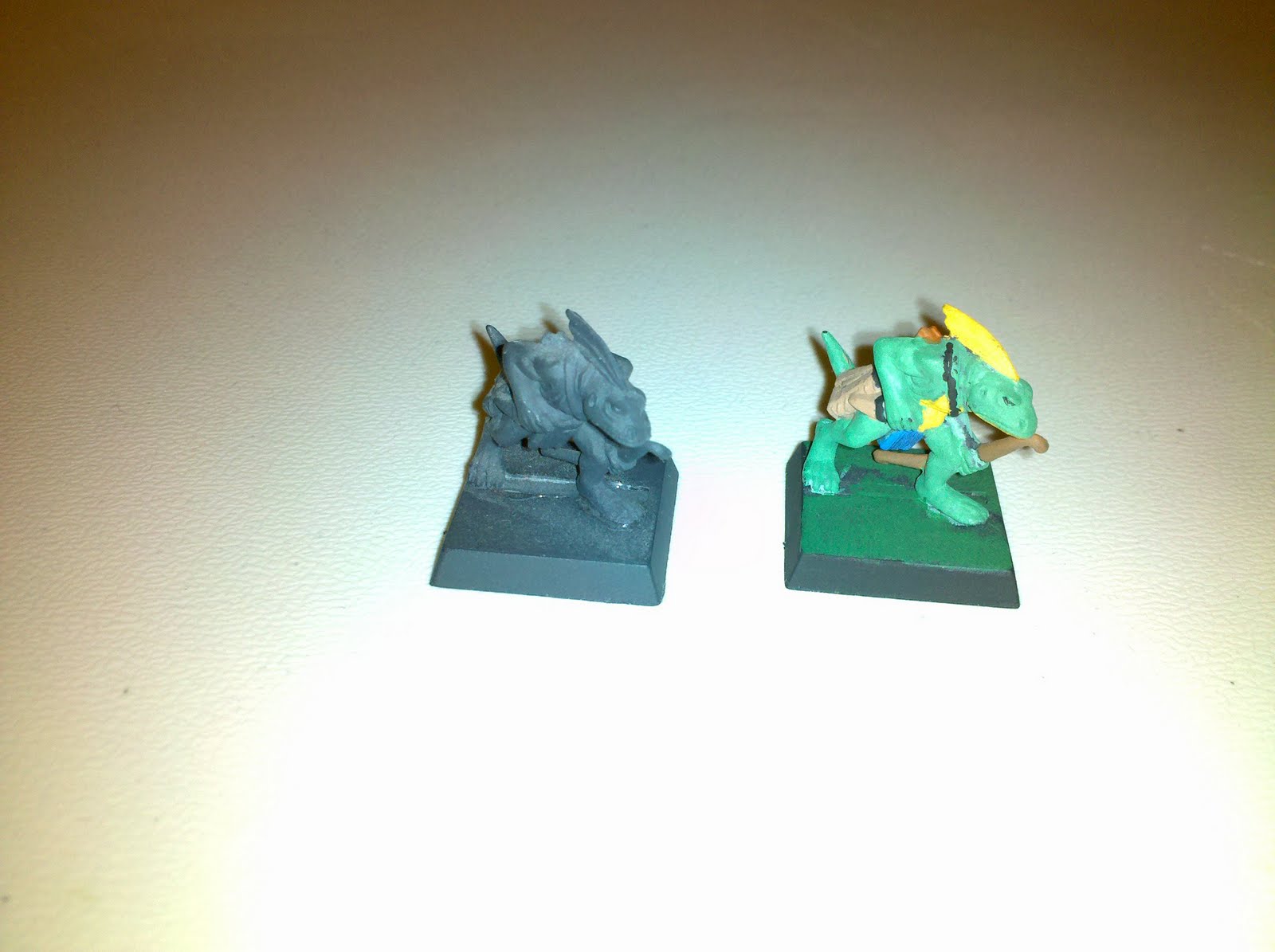
Prior to the week of sickness, I had attempted to start painting again in the form of Warhammer models. Being as that I could feel the sickness coming on even as early as Friday (6/26) and my nose kept running, it made painting rather challenging. I mean, try painting a 28mm detailed miniature while having to stop every few seconds to grab a Kleenex. To the left is an unpainted model next to the one I painted (a task that took me several days to complete because I didn't feel well enough until late Wednesday (6/30) to finish some of the details, hence the reason only one out of a few dozen has been painted). As you can see, I suck at painting. To give myself some credit, it's the first time I've painted anything like that in over ten years, so I actually did pretty good. Now I just have to nut up the gumption to try things like washes and dry brushing to bring out the minute details in the model. I never was all that good at either of those techniques, probably because when I was a thirteen year old D&D geek, I didn't even know those techniques existed. I always liked to look at pictures of completed models and miniatures and always wondered how they got them to look so vibrant. Well, now I know, I just need to learn how to do it myself. So, the one model I've painted is technically incomplete from a certain point of view – but I had fun painting it and I've got plenty more models in the one Warhammer boxed set I own to keep practicing on (it's not like I can't strip it and repaint it later after I get good at it).

Speaking of Warhammer, I'm afraid to admit that it's causing me to become somewhat of an eBay junkie. I'm not going overboard buying and bidding, but I do have about a dozen or more things that I'm watching at any given time. I've logged into my eBay account more in the last two weeks than in the last two years I think. Previously I was looking to rebuild my collection of role playing game books. Now I'm searching for deals on Warhammer 40,000 models. It's a good thing too, because I have to admit, the prices on eBay are tons less expensive than actually going through Games Workshop itself. Case in point, the “Space Wolves Battleforce” retails for $90 on GW's website, but I've found it for as little as $64 (or less) on eBay! Of course, I have to keep an eye on how much folks are charging for shipping else I'm right back to paying as much as I would from GW.

In other online ordering news, I finally decided to order some Johnson Creek Smoke Juice to try to refill my spent e-cigarette cartridges myself. Being as how most of my empties are menthol, and I really didn't want to find out what it would be like to mix flavors, I ordered a half ounce bottle of their Arctic Menthol smoke juice. At only about $10 (plus shipping) for a half ounce bottle, it's actually way cheaper than ordering the actual cartridges from Red Dragon which would run around $12 for four cartridges. The trick now is to figure out just how much to drip into the cartridges. To much, and it'll leak (and I'm sure that would taste just nasty) and to little would be like I never put anything in them at all. Of course, everyone else's opinion is that I should just quit smoking altogether. Naturally, that would be ideal, but until I can work on overcoming the nicotine addiction completely, I'll keep using the e-cigarettes as a way to reduce my actual smoking. Incidentally, for those of you who smoke – who do you find to be more obnoxious, those who have never smoked, and therefore have no idea how hard it is to quit, or those who have managed to quit and act all superior because they were able to and you haven't yet? Just curious.

In the general mayhem department, well, the flu causes just that. Being sick always sucks, but when it causes you to miss work when you get paid by the hour, it really sucks. When sickness means not even being able to read or write or paint or whatever else you enjoy doing, then it just makes the days you are sick seem that much longer because all you can do to pass the day is either sleep, or watch TV in a cold-medicine haze. Eating isn't enjoyable because you can't taste anything, and you feel like if you see another can of chicken noodle soup you're going to scream (which, of course, would hurt like hell because of the sore throat).

The other thing being sick slows me down on is job searching. I like my job – there's something about taking a shoulder of bull-hide and turning it into a bunch of quality belts or seeing it become a batch of gun holsters that's pretty cool. But it's not a career. With my fiancee actively searching for work in her field, now that she has her Master's degree, I also sort of need to have a job that would allow me to easily transfer. I've hesitated about filling out applications with places, like BestBuy for example, because of a slight sense of loyalty to my current employer (who's also my uncle by marriage) and also because of things coming up like Jury Duty that could interfere with things. Not to mention, I'm not really sure I want to go back into working retail again, but hey, that's what I know and what I'm good at; plus someplace like BestBuy could lead to experience in actual computer technician work while working on a degree and/or certifications in the Information Technology (IT) field at the same time. Anyway, I need to sort that out soon... very soon.

~ JC

Sunday, June 27, 2010

The Hammer of War

I really have to stop saying “never.” I said I'd never write a blog – yet here I am, as I am almost every Sunday morning writing a blog. I said I'd never play World of Warcraft – I ended up addicted to it for a year and a half. And, of course, I said I'd never have a MySpace, Facebook or Twitter account, and yet I have all three! So, here's my latest never that's about to be trumped – I'll never play Warhammer. Yeah, right.

Now, I have good reasons to say that I'll never play Warhammer, or it's Sci-Fi cousin Warhammer 40,000 (or 40k for short). First of all, it's expensive as hell! Have you ever priced any of this stuff? The starter kit is $90! $90!? Really? For a friggin' tabletop game, that you have to put the damn pieces together yourself!? Fuck that! Then there's that – the having to put them together yourself. I mean, Axis & Allies was a fairly expensive board game at around $50, but at least the pieces were already together – we opened the box, read the rules and started playing right away. But not Warhammer; oh hell no. You have have put the models together and paint them first. WTF? Several years ago a friend of mine actually gave me a starter set for Warhammer: The Game of Fantasy Battles. He had won it or something. It seemed intriguing at the time, but then I found a hobby shop that sold the extra pieces for it and noticed the price of the stuff. It's like one part model building/painting mixed with one part collectible card game/deck building. You keep building and expanding your army. You buy more models, put them together, paint them, then find other people who've done the same and have table top battles.(1) I like the concept to be honest. Strategy, luck of the dice – I even like the model building and painting thing. But why in the hell do these things cost so much? I'm sorry, but no one is ever going to convince me these things are fairly priced. $90 for a box of little plastic models I have to paint and put together myself is pretty ridiculous. And yet, yesterday I went out and got paints and brushes so I could start painting the models I was given years ago.(2) I'm watching eBay for deals on 40k models so I can start building an army of Space Wolves. I've obtained the rulebook and codex for the 40k army I want to build so I can learn how to play. Truth be told, I'm more interested in the modeling part of the process than I am the game at this point, mainly because the only people I know who could teach me to play live hundreds of miles away, and one of them is even in a different time zone. But that doesn't mean I can't enjoy the relaxing hobby of building and painting models like I used to when I was a kid. And if I'm going to start building models, I might as well let it tie in to my normal gaming-geek nature and let those be war gaming models, I suppose.

~ JC

(1) To explain, in brief, for those to lazy to click on all the links I've provided and go read up on it for yourself – the starter kits are plenty for you to be able to play the game. But most people get into the hobby as a whole, that being the collecting, building and painting of the models and thereby being able to improve and expand one's army. The game uses a point system to keep things fair, so some guy who only owns, say 410 points worth of models (which is about what the starter box for the Space Wolves I plan to play is) isn't going to get crushed by the guy who owns 2000 points worth of models (like my best friend's Blood Angels army that he's built over several months). The guy with the 2000 would have to reduce his force proportionately so the match is fair.

(2) I don't really plan to play either of the armies that came in the Warhammer Fantasy set I have. I'm just going to paint them so I can practice painting miniatures. I haven't painted miniatures in almost a decade and a half (back then minis were just something we used as a visual aid for D&D and not an essential part of role playing – but that's another rant for another time)

Sunday, June 20, 2010

Keep Rollin', Rollin', Rollin'

Anyone who's read my blog regularly knows I'm a bit of a gamer. My roots go back to 1st edition Advanced Dungeons & Dragons and I even dabbled a bit in Star Frontiers and Top Secret. More recently I've been playing Palladium Fantasy Role-Playing Game™ and Rifts® with plans to possibly start playing in the World of Darkness system. The one thing all of these games, and others like them, have in common is dice. Even though the main premise is to create a character and develop a persona for that character, there are situations that just can't be role-played. Combat is the most typical situation (roll to see if you hit your target, roll to see how much damage you did to the target, etc.), but there are others – e.g., you can't just tell the Game Master, “I kick down this door” and that's that; dice are rolled to determine if you were successful or if the door was just to solid for you to kick down. Anyone who has ever played, or seen played, a typical role playing game knows that the dice used are not (necessarily) the typical 6-sided cubes found on a Vegas craps table. Pictured below is my current collection of dice:


As you can see from the photo, the aforementioned cubes are present, but there are several others ranging from 4-sides to the famous D20 (20-sided die). During my off-again-on-again “career” in D&D et.,al. I've owned several sets of dice. Hell, I practically used to collect them* and at one time I even owned a couple of 30-sided dice, although I'm not quite sure why I bought those other than the novelty of them. The interesting thing is, the above set of dice never come out of the bag anymore. With my group being flung from North Carolina to Texas and even all the way up to Michigan and our getting together using online tools such as OpenRPG and Ventrilo, we use virtual dice these days. The dice buttons in OpenRPG that allow us to “roll” for combat attacks and damage serve their purpose I suppose, but sometimes it just doesn't quite feel the same, you know? I love that my buddies and I found a way to continue playing even though we live hundreds of miles apart from each other, but I still miss breaking out my dice bag every week. It also has me wondering about the accuracy of the virtual dice versus the real thing. Now, it's been fifteen years or more since I took that class on Finite Mathematics (and for that matter, I withdrew from it), so I'm not going to attempt to calculate probabilities of rolling a 20 on a D20, blah, blah, blah. But what I did do was roll my favorite real D20 (that would be the purple one in the picture above), the virtual D20 in OpenRPG and a virtual D20 in an app called Dice Bag on my MotoDroid ten times each just to see what kind of results I'd get:
  • Real D20: 11, 17, 5, 10, 2, 4, 10, 9, 1, 10
  • OpenRPG D20: 3, 15, 20, 11, 1, 7, 19, 2, 4, 17
  • Dice Bag App: 19, 19, 6, 16, 1, 11, 8, 14, 20, 4
Ok, so I really don't know what any of that means, but it was a fun experiment to do. Seems like the OpenRPG rolls seemed the most balanced ranging from low to high, while the Dice Bag rolls were a bit overpowered and the real D20 stayed pretty average. Interesting how all three gave me a 1 once while the real D20 was the only one not to come up with a natural-20. Either way, be it plastic, metal, or virtual, I'll keep rolling the dice.

Huzzah!
~ JC


*NOTE: I used to own a lot more dice sets than I currently do. During my fundamentalist-right-wing-Christian phase of life, I probably trashed or burned them. Sad, eh? That I'd allow a religious group to so influence me that I'd believe a game could do me spritiual and mental harm? But that's a whole separate issue (hmmm.... maybe another blog topic for the future? We shall see).

Sunday, April 11, 2010

All In My Head

This week's blog is kind of a part two to last week's. I am again going to regale you with information and opinions on the world of role playing games (RPGs). Last week I did a very vague comparison of two similar table top gaming systems. It dawned me though, as often as I talk about role playing games and my love for them, I've never really gone into the hows and whys of me playing them.

I think I bought my first role playing game when I was around 12 or 13 years old. It was called “Star Frontiers” and came in a purple box with two rulebooks; one was a 'quick-start' guide, the other was the full game. It also came with a big poster size map and little cardboard pieces with various things on them for use on the map. It also came with two of the oddest dice I had ever seen – the had ten sides instead of the traditional six. Truth be told, I never really got a chance to play “Star Frontiers”. When I mentioned it to my friends, they were like “Oh, it kind of sounds like a science-fiction version of D&D.” “What's D&D?” I asked. And the next thing I knew I was out looking for and buying the 'Dungeons & Dragons Basic Set'. We spent many an after school afternoon, not to mention summer vacations, playing D&D as often as we were able. I pretty much was always playing the fighter, and had a hack-and-slash sort of style of play. As we matured (both in age and as players) we moved to Advanced Dungeons & Dragons, with its larger selection of race and class combinations, weapons, armor, spells, etc. Over the past 25 or so years, I've been both a rabid player/Dungeon Master and a vehement opponent of D&D and role playing games. I'm happy to say that now, at 38, I've found a balance in gaming and real life responsibilities. But, that's just a brief history of how I started playing. It doesn't explain much about why I keep playing these games even though I'm almost 40.

So, as I've mentioned before in previous blogs, there are those that do not quite understand RPGs, and there are those that just plain make up a bunch of bullshit about RPGs and call them evil and satanic. I have actually had someone look me in the eye and seriously tell me “You know, the spells in D&D are real, actual spells.” Really? Are people really that frakkin' stupid? Because, yeah, every book on Wicca I ever read contains the spell “Magic Missile” right? Gary Gygax, the co-creator of Dungeons & Dragons, and the father of all role playing games, said he just made those up off the top of his head. But, I digress. You see, the first reason I play these games is simple; they're fun. If you don't think so, that's fine. I personally don't have the patience to play Xbox and PS3, etc. I'd rather delve into a RPG in which the game master has developed a good story to go with the action and it's not all “kill everything that moves, kill some more, loot that box, then go back to shooting.” Fun for you and fun for me can be two separate things – that's fine. It's call diversity. So, I play RPGs because I personally find them to be fun. Period. End of discussion.

Now, for a second reason I continue to play D&D and the like? Easy – it feeds my creative vent. I've always wanted to write a novel. Alas, I'm not that great at it. I've made a couple of attempts and either only manged to write a few scenes or just plain realized that what I was writing was entirely to much like a combination of several other books I've read (and I really don't want to be sued). By playing a role playing game, I can participate in a sort of consortium of writers all contributing to the same story. We each have a part to play, and therefore a part of the story we are filling in the details about. Other times, when I've been the game master, I've gotten to create a plot and other devices to get the players involved in the story, letting them write the dialogue and actions for their characters. The other half of the creative aspect is making maps. I know, it sounds weird, but I've always had a thing for looking at maps, so in D&D I get to make my own maps. I'm not an artist, so making D&D maps is as close as I've ever gotten to creating a masterpiece work of art.

And finally, I would be remiss if I left out another large portion of what playing role playing games has done for me. This isn't so much a why I play as it is an I'm glad I play because it's helped me in this area. Growing up, I was an A-B student for the most part. The thing is, I hated to read. Getting me to sit and read a book was like trying to get a cat to take a bath. When I started playing D&D, suddenly I began to want to read more – mostly fantasy novels at first, but eventually history, religion and philosophy as well. To be totally honest, my original reasons for reading more was so I could get ideas for the game. The more I read though, the more I gained interest in the subjects I was reading. Role playing games also require a certain amount of math skills (at least basic math) as well cognitive reasoning abilities. Frankly, I feel like if I had not started playing these games, I probably would not have had as much of a love of reading as I do now, nor would I have had any use for wanting to learn about history, philosophy and religion. These games helped me learn how to think. Sorry, but no console based first person shooter that requires nothing more than pushing buttons is going to do that. Sure, today's high tech video games may develop a certain amount of hand-eye coordination, but I've also seen a lot of mindless zombies with no attention span for anything else result in them as well. Sometimes, it's nice to kick it old-school with D&D, or RIFTS or any other table top role playing game. It sort of goes toward showing that I don't need a computer monitor to paint the picture for me; I can use my imagination and let it all be in my head.

~ JC

Potential future topics here at Carlisle's Chaotic Commentary
  • “Lucky 7” (my review/feelings about my switch from Windows XP to Windows 7)
  • “I Need A New Drug” (overcoming my WoW addiction, but still wanting to play an MMORPG)

Sunday, April 04, 2010

This is How I Roll

I've been playing role playing games, of and on, since I was about 13 years old. In that time I've dabbled in a few different gaming systems, the most prevalent of which is the various versions of the classic, and most well known RPG, Dungeons & Dragons. There are still some (mainly fundamentalist, right wing Christians) who think these games, especially those in the fantasy genre, are evil and “of Satan.” The truth is that there is really nothing in any of these games that has every influenced any of my religious beliefs. While it is true that these games, like any fantasy novel, do borrow concepts from many myths and philosophies both ancient and modern, those ideas/beliefs get muddled into a completely fictional setting. Playing D&D and the like, for me, actually caused a development of a love for reading, history, philosophy, et cetera. But today's blog is not about me espousing the virtues or reasons for indulging in role playing games; it is about comparing two such systems, namely Dungeons & Dragons (aka, the D20 System) and Palladium Fantasy Role Playing Game.

Several months ago, as we were weaning ourselves off of our World of Warcraft addiction, my best friend and I were discussion how much we missed the old school table top role playing games. The idea of a group of friends sitting around a table, rolling dice and actually immersing ourselves into playing a character versus sitting in front of computer mindlessly pushing buttons sounded pretty good to us. One of the things we had done to try to stop playing WoW was to try out Dungeons & Dragons Online, because it was free to play. It was playing DDO that got us to talking about wanting to play D&D again. The problem was, I live in North Carolina, he lives in Georgia and the rest of the guys we thought might be interested in playing D&D again were spread out across other parts of NC, Texas and Michigan. We were already used to using a program called Ventrilo (“Vent” for short) while playing WoW, which would allow us to speak to each other, but we still needed to be able to see each others' dice rolls, the map and miniatures. That's when we discovered OpenRPG, which is a virtual tabletop program allowing for all that. And so, with a little recruiting and instruction on how to download, install and setup Vent and OpenRPG we were able to begin our project of once again enjoying D&D without having to all be in the same physical place. Not long after we added the game RIFTS to our repertoire of games to play on Saturday nights. Rifts, being a Palladium system game, is what has led us to where we are now; converting our D&D characters to Palladium Fantasy RPG characters.

RIFTS was my first introduction into the Palladium Books system of games. Other than a few other, smaller games (such as Star Frontiers and Top Secret) I had pretty much played D&D exclusively my entire gaming life. There were a lot of similarities between D20 and Palladium, but there are a lot of differences too. As to which is the superior system, well I guess that's subjective but I'm starting to find that the D20 system is to limiting and basic for our tastes. Hence, the decision to convert from D&D to PFRPG for our fantasy genre game. There are, of course, pros and cons to both, and no RPG system is perfect. Our group simply prefers Palladium for it's more realistic combat style and the ability to have a more customized character than is possible in D&D/D20.

I've found forums on which people have complained that Palladium is an archaic gaming system (it was first introduced in the early 1980's). Maybe, but there's an old saying, “If it ain't broke, don't fix it.” D&D wasn't broken, in my opinion, yet TSR, Inc. decided to launch 2nd Edition Advanced Dungeons & Dragons in 1989. AD&D 2e was horrible! It took all the flavor out of D&D (certain races and classes were taken out) and introduced “THAC0” as a game mechanic which made the combat rolls more difficult to calculate than simply using the various charts found in the original AD&D. Not long after, TSR, Inc. was bought by Wizards of the Coast, who rescued D&D from oblivion since TSR was on the verge of bankruptcy. Uncer WoTC, D&D was reborn under a 3rd Edition which introduced the “D20 System” and the “Open Gaming License.” This was actually quite brilliant as it opened up the market to development of materials for the game from multiple sources. It remains, in my opinion, the best version of D&D to ever come down the pike (sorry, I'm not interested in 4th edition D&D as I feel it has digressed into being to much of an amalgamation of miniatures and MMO-type combat mechanics). So, while D&D has introduced various editions and changes over the years while Palladium has stuck with its tried and true system since 1983, I still contend that Palladium's system still works just fine.

In both games it is necessary to create, or “roll”, a character before you can begin play. While I'll admit here that D&D has the edge over Palladium on time consumption and simplicity in the character creation process, Palladium seems to allow for more well rounded and unique/customized player characters (Note: since I currently play a Wizard in my group's D&D campaign (and forthcoming conversion to PFRPG) I'll be using that character class as my example later in this blog). The basic process in D&D goes something like this:
  1. Choose a race (human, elf, dwarf, etc.) and class (fighter, wizard, rogue, etc.)
  2. Roll dice to determine ability scores (Strength, Intelligence, Wisdom, Dexterity, Constitution, Charisma)
  3. Select Skills & Feats
  4. Select Spells (if your class uses them)
  5. Roll dice to determine how much money (gold pieces) the character begins with and buy equipment (armor, weapons, etc.)
The process in Palladium is almost identical (roll for ability scores*, pick skills), but the difference comes in selecting skills (Palladium doesn't use “feats”). In D&D, each class has a set of “class skills” which they can use their skill points on at full value (1 point for 1 rank ratio) and the rest are considered “cross-class skills” which are taken at half value (in order to gain 1 rank, you have to “spend” 2 points). In Palladium, you can pretty much take any skill you want (with some restrictions), but your class gets bonuses for certain categories of skills. What this means is, in D&D a Wizard is pretty much a Wizard, while in Palladium, a Wizard can take weapon proficiencies or other skills that could allow him to have rogue like abilities or even be highly skilled with a sword and become a “War Wizard” if he wants. In short, Palladium isn't as limiting in what the various classes can or cannot do as D&D seems to be. Palladium also assumes a certain amount of starting gear the character already owns, which makes more sense to me than having to go buy it. Admittedly, I can create a D&D character is less than half the time it takes me to create a Palladium character, but part of that is the fact that I'm still learning the Palladium system.

The combat system is probably where I've seen the most criticism of the Palladium system, with claims that it “takes to long” and causes the game to “bog down.” I have to laugh at that, because that's pretty much how my group feels about the D20 combat system, and we find the Palladium system to be both faster and more realistic. This is due to the fact that D&D (especially the 3rd and 4th editions) essentially requires the use of miniatures and a map-grid when engaging in combat. The D20 System of combat (without going into a lot of overt detail) works something like this:

Attacker rolls a 20-sided die, add/subtract any bonuses/penalties to that roll;if the result matches/exceeds the target's “Armor Class, the attack hits; roll
to see how much damage you do based on the weapon you were using; defender
subtracts damage from their “Hit Points”; repeat until until someone quits or is
dead/unconscious (hit points at zero or less).

Sounds simple enough right? Well, it is, but where it fails for me is that because of the whole Armor Class thing, you basically have to stand there and take it when someone rolls a successful hit. Where D20 bogs down in combat is the having to move around miniatures, which becomes tricky with rules like “Attack of Opportunity”, which is a sort of ridiculous rule in my opinion (I won't go into detail about it because it would take to long, but you can click on the link to find out more if you'd like). By comparison, Palladium combat becomes a bit more realistic:

Attacker rolls a 20-sided die adding/subtracting any bonuses/penalties to the
roll; a result greater than 4 is a potential hit; defender can either attempt to
parry or dodge the attack by also rolling a 20-sided die and adding/subtracting
bonuses/penalties; if the Defenders roll matches/exceeds the attacker's roll,
then the attack fails; if the defenders dodge or parry roll fails, then the
attack is successful and attacker rolls for damage; if the damage roll does not
exceed the Armor Rating of the defender's armor, then the defender, nor the
armor take any damage; if the damage roll exceeds the Armor Rating, the the
remainder deals damage to the “SDC” of the armor first until it is destroyed;
once the armor has been broken through, then the defender begins subtracting
damage directly from his hit points; rinse and repeat until someone quits or is
dead/unconscious (hit points at zero or less).

Ok, so Palladium's combat sounds more complex, and it is. But the point is, it's more realistic. The player has the choice to either stand there and take it or try to dodge or parry an attack, while in D&D, your hands are tied – all your abilities to parry or dodge are automatically built in to your Armor Class. If you have a low AC, you are pretty much screwed, but in Palladium, even an unarmored, non-man at arms, character has a chance to either parry or just plain get the hell out of the way. I also like how Palladium uses a combination of damage mitigation (Armor Rating) and the concept that the Armor itself absorbs damage (SDC) before the person does until the armor is destroyed. It also adds the realism that the character will, eventually, have to have his armor repaired or replaced. I can see where some think that Palladium combat can bog down and take to long, but I prefer its realism and flexibility versus D&D's use of miniatures and basically reverting to board game when combat breaks out. Also, D&D combat can bog down much worse than Palladium's when non-standard actions (actions other than simple attacks) such as grappling and tripping are attempted (again, there's just to much information to even attempt to explain it all here).

Where Palladium really shines over the D20 System is the use of magical abilities and spells. Palladium magic works more like the magic seen in movies and fantasy novels. While in D&D, a Wizard for example, has to carry around a spellbook and spend time each morning memorizing the spells he wants to have access to that day. The D&D Wizard is also limited in which spells he is allowed to learn (my Wizard is 5th level, but only has access to spells up to 3rd level in power) and how many of each level he can memorize and cast per day. Palladium, on the other hand, uses an ability called “Potential Psychic Energy” (PPE) which is indicative of how much magical power the Wizard possesses. The Palladium Wizard can also learn spells of any level at any level of experience (e.g., a 1st level Wizard can learn and cast a 9th level spell). Each spell has a PPE cost; as long as the Wizard has enough PPE in reserve and knows the spell, he can cast it at anytime. Rest, sleep or Meditation allows the Wizard to replenish his spent PPE, and as the Wizard gains levels he gains more PPE and therefore becomes more powerful. I love the fact that my Palladium Wizard will never have to say, “Wow, I know a great spell that would be helpful in this situation, but I didn't memorize it today so I can't use it.” versus the D&D Wizard suddenly becoming useless in such a situation because he didn't prepare the “correct” list of spells that day.**

Don't get me wrong – I'm not shitting on D&D. I still think it's a good (if somewhat rudimentary/introductory) role playing system. I just like the Palladium system better, particularly when it comes to skill selection and use of spells and magical abilities. Both systems have strong and weak points. D&D defiantly has the advantage on resources of materials and tools since it allows its fan base to produce and share materials via the internet and other sources. Palladium, without a doubt, needs to ease up on its stance on copyrights and intellectual properties (they've actually gone as far as suing or threatening to sue people for doing fan-sites on the internet). So, in a nut shell, I hate how Palladium the company (particularly the CEO) does business, but I love the gaming system itself. Comparatively, I really love the way Wizards of the Coast markets D&D and allows fan-sites and other publishers to produce materials, but find the system itself to be a little lacking in areas such as realistic combat and character customization.

Whichever system you choose, enjoy and keep those dice rolling!

~ JC

* Note: the ability scores in Palladium (and their approximate D&D equivalent) are Intelligence Quotient (Intelligence), Physical Strength (Strength), Mental Endurance (Wisdom), Mental Affinity (Charisma), Physcial Prowess (Dexterity), Physcal Endurance (Constitution), Physical Beauty (no specific equivalent but Charisma basically covers it), and Speed (no D&D equivalent).

** This is only a small sampling of how the magic systems work in both D&D and Palladium as both systems have several classes that can cast spells, and have different types of spells, not to mention how the two systems handle psychic ability.


Sunday, January 17, 2010

Sometimes It's the Simple Things

We live in a fast food, video game society. We want what we want, and we want it they way we want it, and we want it right now. I, too, have succumbed to the world of Massively Multi-player Online games, only recently overcoming that addiction. As I get older, though, I find myself wanting to do nothing more than relax in my favorite chair and either read or watch TV. In fact, now that I've overcome my overwhelming need to play World of Warcraft (or should I say “Warcrack”), I'm rediscovering the joy of reading and actual role-playing games (let's be honest, WoW and the like call themselves RPG's, but they really aren't).

At the end of November my friends and I figured out a way to play Dungeons & Dragons despite being hundreds of miles apart from each other. Last night, we expanded that experience to include the game RIFTS. We also have plans to begin delving into the World of Darkness eventually as well. Now, it may seem strange to most that at the age of thirty-eight I still find enjoyment in this kind of entertainment, but as they say, sometimes it's the simple things in life that give us the most pleasure. Just like I enjoy losing myself in a good book, role-playing games are a way to lose myself in a living novel that I get to help write on the fly.

Anyway, all I'm saying is, don't get caught up in the fast paced bullshit that plagues us in the 21st century. Slow down, enjoy some simple pleasures. Yep, the life long geek is telling you to back off the technology for a bit – go figure.

~ JC